
I first read the Bhagavad Gita in 2014. My mind was deeply restless. I was searching for a Krishna—someone who could hold my hand and take me far away from the conflicts and dilemmas of life.
But as I began to enter the depths of the Bhagavad Gita, I discovered something profound: the Bhagavad Gita is perhaps the deepest voice of a broken human mind in the history of mankind—a voice that emerged from silence. And in essence, the Gita was not born from Krishna’s anxiety, but from Arjuna’s restlessness.
As long as Arjuna stood firmly as a warrior, there was no Gita.
The moment he broke down… the moment he said, “I will not fight”…
That was the moment truth began to speak.
On the battlefield of Kurukshetra, Lord Krishna was not merely giving a sermon.
He was giving birth to awakening.
The Gita has 18 chapters and 700 verses—but these numbers can deceive you. Because the Gita is not understood by counting its verses; it is understood by living them.
It is not merely a religious book.
It is the operating system of human consciousness.
It says:
Perform your actions… but do not become attached to their results.
Fight… but preserve peace within.
Live… but do not live through the ego.
Now the question arises—why has the world bowed before the wisdom of the Gita?
Because it does not belong only to Hindus.
It does not belong to Muslims, Sikhs, or Christians.
It belongs to humanity.
Albert Einstein is often associated with the idea that reading the Gita offers a glimpse into the deeper laws of the universe.
J. Robert Oppenheimer, who led the scientific effort behind the atomic bomb, recalled a verse from the Gita after witnessing the first nuclear explosion:
“Now I am become Death, the destroyer of worlds.”
Why?
Because power without consciousness can become a force of destruction.
Mahatma Gandhi regarded the Gita as a profound source of spiritual strength, returning to its wisdom whenever he faced difficulties.
Henry David Thoreau was deeply influenced by the Gita and described its effect on his inner life in remarkably powerful terms.
Ralph Waldo Emerson also admired its timeless wisdom and saw in it a text that could speak to every age.
Aldous Huxley regarded the Gita as one of the clearest expressions of what he called the “Perennial Philosophy”—the timeless truth that transcends the boundaries of individual religions and cultures.
Hermann Hesse, Carl Jung, and many other Western thinkers also found in the Gita profound insights into the inner workings of the human mind—a kind of inner psychology articulated thousands of years ago.
And if I speak of my own experience, for me the Bhagavad Gita is the science of life.
It teaches me that you should not run away from the battles of your life.
You must understand them—and face them.
The Gita does not turn you into a saint or an ascetic.
It makes you a conscious warrior.
It tells you:
You may run away, but suffering will still follow you.
You may fight, and suffering may still come.
But if you fight with awareness—if you fight consciously and understand what you are fighting for—then you move toward freedom.
And the deepest truth is this:
Krishna is not outside you.
Arjuna is not outside you.
👉 Arjuna = your confusion
👉 Krishna = your consciousness
Whenever you become confused, whenever you break down, whenever you begin to question—
that is where the Gita begins.
So remember:
The Gita may not truly be understood inside a temple.
The Gita begins to reveal itself when you stand in the Kurukshetra of your own life—
when your hands are trembling,
when you do not know what is right and what is wrong,
when you are caught between duty, fear, attachment and uncertainty.
And then, from somewhere deep within, a voice arises:
“Rise… this is not the time to run away.
This is the time to fight—with awareness.”
What is the essence of the Gita in one line?
“Life is a battlefield…
but the real victory is not outside you; it is within.”
Now the decision is yours—
Will you remain Arjuna, lost in confusion?
Or will you awaken the Krishna within you?
Jai Shri Krishna 🙏
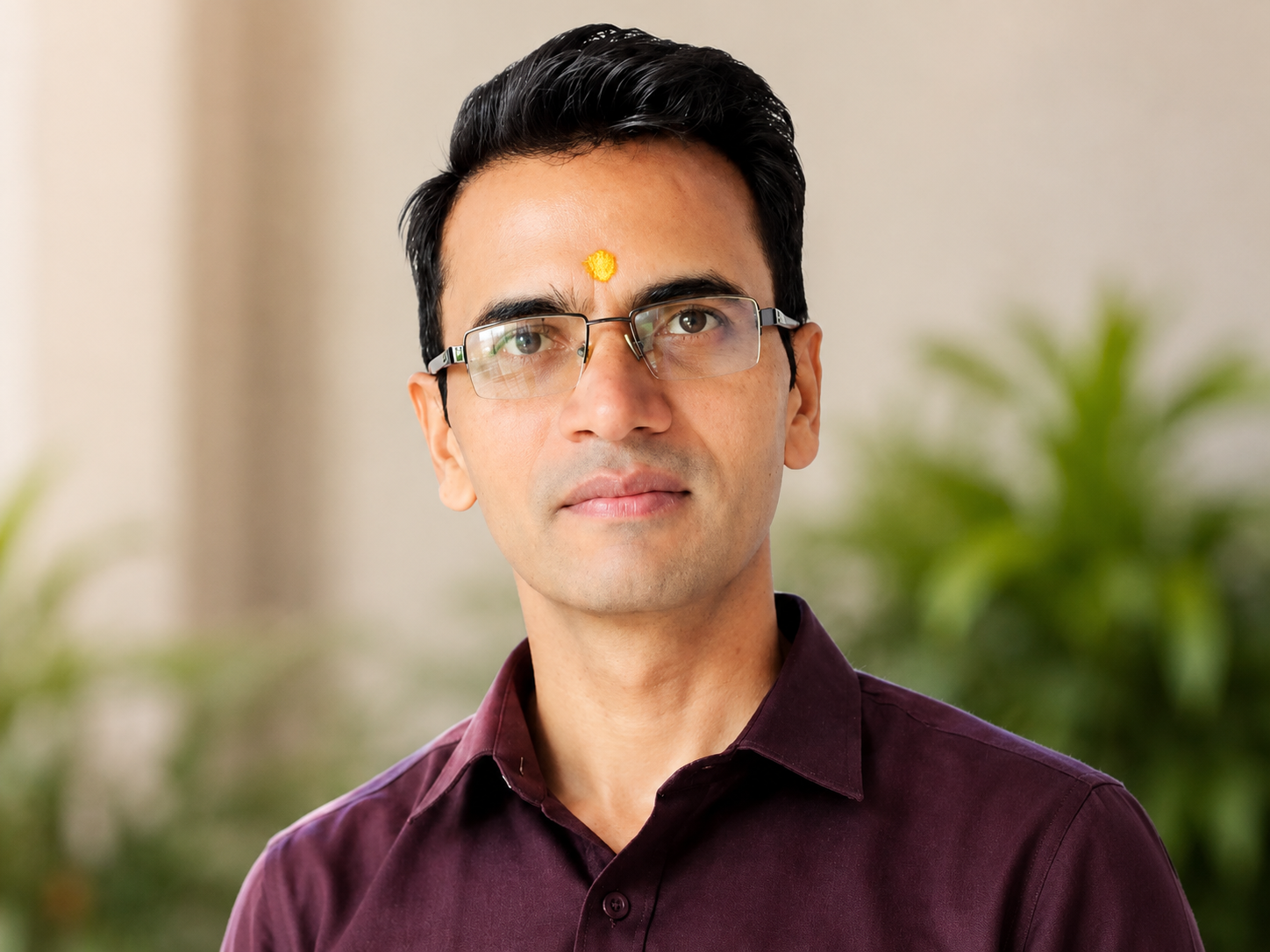
✍️ Dr. Ramesh Singh Pal
Senior Scientist & Author
www.rameshsinghpal.com